An online Ijazah course is an advanced route whose eligibility should be checked before a learner in the United States buys classes. Baynnat Academy publishes an online ijazah course and describes assessment before a certificate is awarded. It distinguishes a memorisation route from a recitation route. A prospective student should therefore ask which authorisation is sought, what prior recitation or Hifz evidence is required, who will examine the work, and whether the currently available teacher can supervise that exact pathway.
This guide is about making an accurate course decision, not promising an Ijazah for attendance or a fixed number of monthly payments. Advanced Quran study is separate from a general Arabic-language course, and learning one skill does not automatically confer another. Baynnat’s published information provides a starting point, but the academy should confirm current criteria and the teacher assigned to a US learner. A written explanation of the route is more useful than a broad claim that a certificate is available online.
Online Ijazah Course in the United States by Authorisation Goal
Start by naming the specific goal. Do you seek an authorisation connected with recitation, or one connected with memorisation? Baynnat’s programme page presents these as distinct paths with different preparation. Ask the academy what each route requires today, what the teacher will hear, and how the final decision is made. A learner who only wants to improve recitation may be better served by a recitation course before considering certification.
Avoid the phrase “get an Ijazah” without a stated reading, form of study and assessment scope. The certificate should relate to what the teacher actually evaluates. Ask whether the intended authorisation applies to a particular Qira’a and whether the examiner holds the relevant authorisation. Those are practical enrolment questions. A US time zone does not change the educational standard, but it does affect which teacher can be available consistently enough to hear the required work.
Online Ijazah Course Entry Assessment
Bring a representative recitation sample, including material you have not just rehearsed for the call. Ask the tutor to identify recurring pronunciation or Tajweed issues and explain whether they affect eligibility now. A student should be able to hear the difference between “you are ready for the Ijazah route” and “you need targeted correction first.” Baynnat’s public page says certificates are awarded only after evaluation; a trial should therefore not be presented as automatic admission to certification.
Request a written account of any preparation recommended before entry. If the issue is reading accuracy, ask which recitation lesson addresses it. If the issue is application of rules, ask whether the Tajweed course is appropriate. If the issue is retention for a memorisation route, ask how it will be tested. An observed difficulty and a reassessment point make a preparatory purchase more defensible than an indefinite instruction to “improve first.”
Online Ijazah Course for Quran Recitation
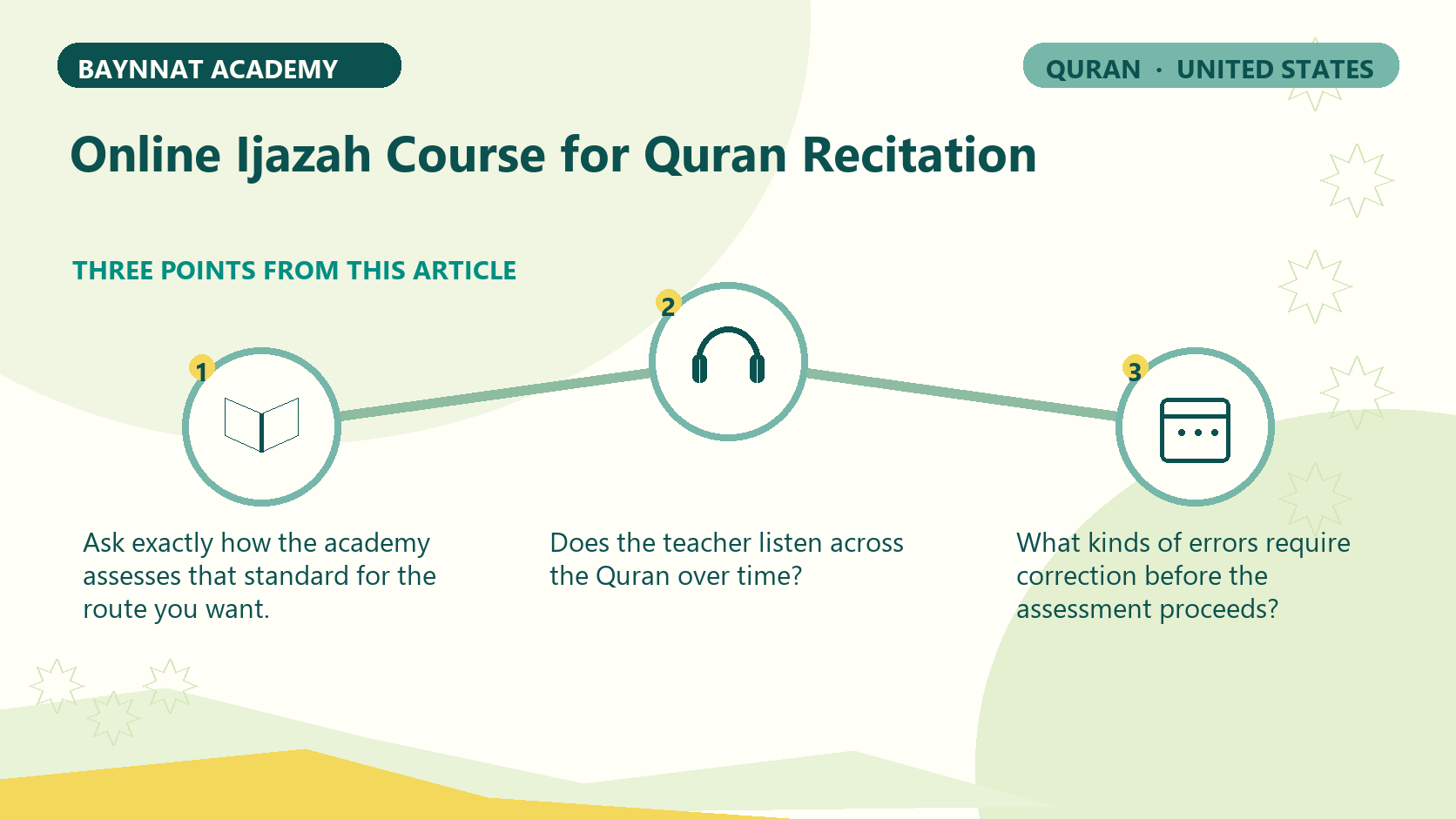
Baynnat’s published Ijazah page describes the recitation pathway as requiring sound Tajweed knowledge and accurate reading and recitation. Ask exactly how the academy assesses that standard for the route you want. Does the teacher listen across the Quran over time? What kinds of errors require correction before the assessment proceeds? What happens when an issue recurs? These questions are more precise than asking only how long the course lasts.
The academy’s page describes full recitation before qualified teachers as part of its process. Confirm the current implementation, including which teacher hears the work and how sessions are scheduled. A new student should not assume that a few excellent short passages prove readiness for the entire route. Equally, the teacher should explain what evidence would show progress toward it. The decision to grant an Ijazah belongs to the authorised examiner after the required work, not to a sales headline.
Online Ijazah Course for Quran Memorization
The memorisation route has a different foundation. Baynnat’s page says a candidate should already be a Hafiz or have completed relevant memorisation study, with Tajweed knowledge. Ask how current retention is tested, not only whether the learner once completed Hifz. Reciting an older passage at an unexpected starting point may reveal a different level of stability from reciting a newly reviewed favourite section. The academy should set the actual assessment process.
If the learner is still working toward complete Hifz, compare Baynnat’s complete memorisation route with the Ijazah programme rather than buying the advanced label prematurely. Ask what competence must be shown before transition and how revision will be maintained. This is not a promise that completing a Hifz course automatically produces an Ijazah; eligibility and final examination are separate decisions.
Qirat Course Online Versus Ijazah Route
A learner may want to study a particular reading without yet seeking authorisation. Baynnat publishes a 10 Qirat course separately from its Ijazah programme. Ask whether the proposed Qiraat study is an educational course, preparation for an assessment, or an authorised pathway in its own right. The name of a course should not be used to imply a certificate if the student has not met the examiner’s conditions.
If you are seeking Ijazah in a specific reading, state it at the first enquiry. Ask whether the assigned teacher is qualified for that reading and whether the intended assessment covers it. Baynnat’s public pages use broad language around Qiraat, so the current boundary of the exact course must be clarified. A learner in America should request this detail before comparing session prices; otherwise two offers with very different objectives may look falsely equivalent.
Online Ijazah Course Teacher and Sanad Questions
Ask for the name or relevant credentials of the teacher who would supervise and examine your route. The concept of sanad concerns a chain of transmission, but a buyer should not rely on a generic statement that an academy employs authorised tutors. Which teacher holds the appropriate authorisation for the specific reading and type of Ijazah? Who makes the final eligibility decision? Ask whether the supervisor and examiner are the same person and how that is documented. Baynnat should answer for the currently available programme, not for a hypothetical future assignment.
It is reasonable to request how the certificate, if earned, identifies its scope. Do not ask for an unconditional certificate before assessment. The academy should explain the process and any documented prerequisites. If a prospective tutor cannot be identified or the reading is unspecified, defer a large commitment until those points are settled. An advanced qualification is too specific to be selected by price and general enthusiasm alone.
Online Ijazah Course Correction and Reassessment
Ask how errors discovered during supervised recitation are handled. Will the learner receive a precise correction, time to practise and a chance to show stable improvement? What happens if a problem remains after several attempts? A robust process should not hide recurring errors behind a pleasant lesson atmosphere. It should also make a path to improvement understandable. The exact standards belong to the qualified teacher and Baynnat’s programme; this guide does not invent a grading rubric.

Keep a private record of passages studied, the type of correction and the next review date. Ask whether that record is compatible with the teacher’s method. It can help you see whether the course is moving toward the assessment standard or repeatedly revisiting the same gap without a changed strategy. Do not turn the record into a self-issued credential. It is a practical aid for the supervised work that an authorised examiner must judge.
Online Quran Classes Before Ijazah Application
Some learners need a sequence rather than immediate entry. A recitation course may address basic errors; Tajweed study may strengthen rule application; memorisation work may be needed for a Hifz route. Baynnat publishes those as separate offers. Ask the academy to put the recommended sequence in plain terms and say what evidence would trigger a move to the next stage. Avoid buying several packages at once without understanding which one is active now.
General Arabic-language study is not the same as Quran recitation or Ijazah preparation. It can be valuable for a separate language goal, but a buyer should ask why it is recommended for this pathway and what it will contribute. Baynnat’s public page describes a broad beginner ladder; the exact starting step should still follow an assessment of this learner. A person who already reads accurately should not automatically repeat an alphabet course because it appears first in a marketing list.
Online Ijazah Course Trial Questions in America
Use Baynnat’s trial request to state your current recitation or Hifz level, desired route, reading if known, and US time zone. Ask whether the available teacher can assess that specific route during the trial or whether a separate specialist assessment is required. Confirm the current trial format directly; published descriptions of the number of trial lessons differ. An introductory call should not be mistaken for a final qualification decision.
After the assessment, ask for a clear status: ready to enter, conditionally preparing, or better suited to another published course. Ask which observed issue supports the recommendation and what the next task will be. If the academy proposes Ijazah study, request the scope, teacher and assessment conditions in writing. This protects both learner and provider from a misunderstanding that payment alone has secured a certificate.
Online Ijazah Course Scheduling Across US Time Zones
Specialist teacher availability may be narrower than ordinary class availability. Give the academy your city or time zone and two realistic lesson windows. Confirm the recurring local hour, including any daylight-saving transition. Advanced supervised recitation can require consistency over a longer period, so the tutor’s actual availability matters. A generic promise of classes at any hour is insufficient if the authorised teacher for your specific route is not free then.
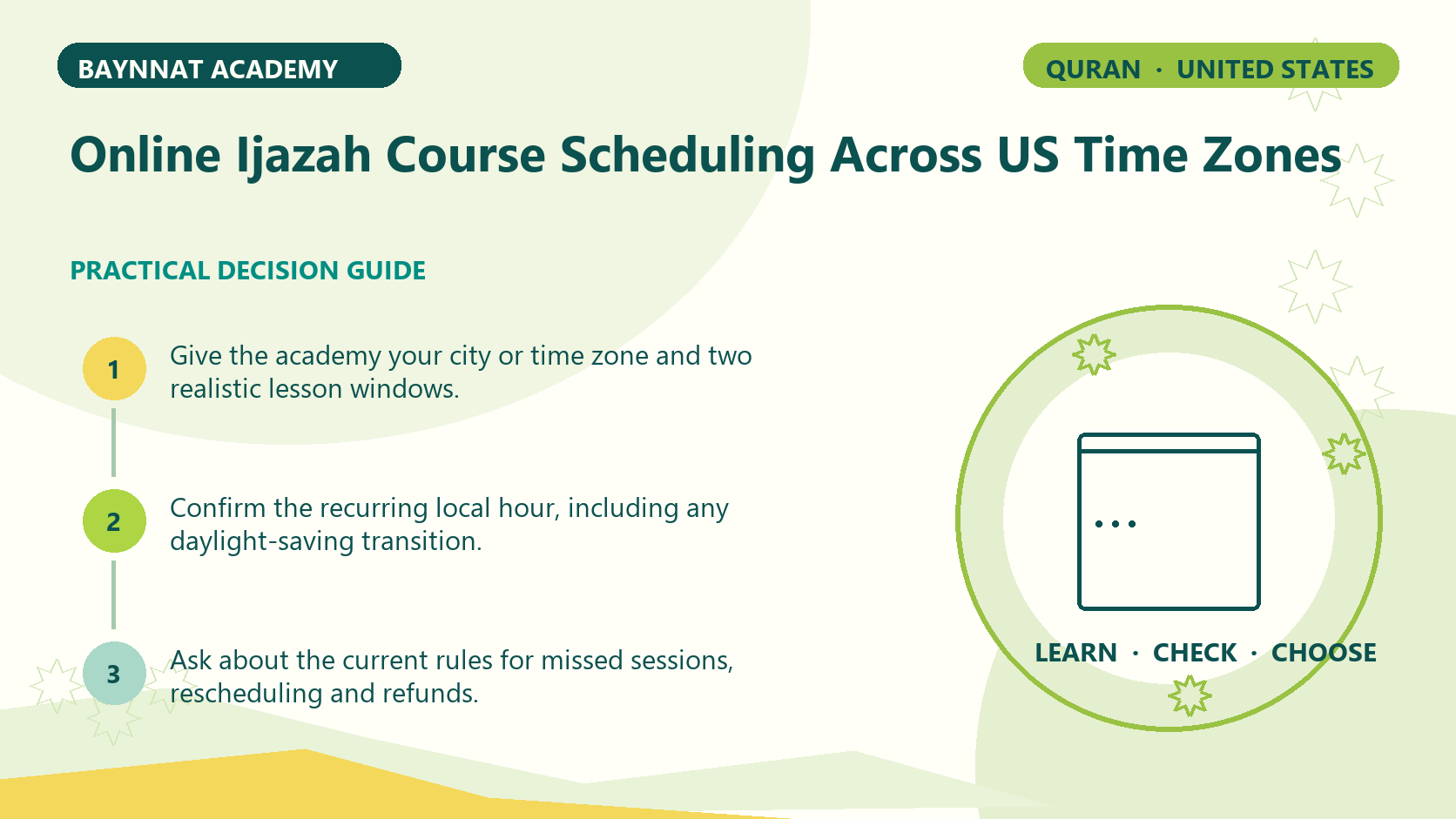
Ask about the current rules for missed sessions, rescheduling and refunds. Baynnat’s public FAQ and terms have differed, so obtain the applicable policy before paying. If you expect travel or changing work shifts, discuss how a break affects the assessment sequence. The educational plan may need review after an interruption. Clear scheduling is part of protecting the integrity of the supervised recitation, not just a customer-service detail.
Online Ijazah Course Pricing and Scope
Baynnat’s pricing page shows monthly class lengths and frequencies in US dollars. Ask which plan applies to the actual Ijazah pathway and assigned teacher. Confirm individual or group format, number and duration of sessions, and any specialist assessment conditions. If the displayed monthly-hours label conflicts with the lesson count and duration, request written clarification. Do not infer that a general class card includes examination or certification unless the academy confirms it.
Compare the cost with the work required, not with a promise of an easy certificate. A candidate may need months of correction and reassessment; another may need a different preparatory course. The number of paid sessions cannot guarantee the final decision. Ask whether any fee relates specifically to examination or documentation and what happens if eligibility is not met. Those are current commercial facts for Baynnat to confirm before a US learner commits.
Online Ijazah Course Enrolment Decision
Before paying for an Ijazah path, ask which recitation sample will be used to decide eligibility and who will make that decision. A course booking and a successful authorization assessment are separate events. A written entry check protects the learner from assuming that a certificate follows automatically from attendance.
Prepare a written enquiry with your desired type of Ijazah, reading if known, current recitation or Hifz evidence, and available US lesson windows. Request the teacher’s relevant qualification, entry assessment, supervised work, final examination process, current price and applicable terms. Compare the answer with the published programme and ask the academy to resolve any difference before you pay.
An online Ijazah course is appropriate when a qualified teacher confirms the learner’s route and prerequisites, the work to be heard is defined, and the final assessment remains contingent on demonstrated competence. If the present evidence points to foundational study, begin with the correct recitation, Tajweed or Hifz route and agree on a reassessment point. Use the trial enquiry to establish that plan; treat a future certificate as an outcome to earn, not an item automatically included in a subscription. Keep copies of the academy’s explanation of scope, fee and assessment. Those documents help you distinguish an educational stage from a final authorisation decision and clarify what you have purchased if your study plan changes later.